




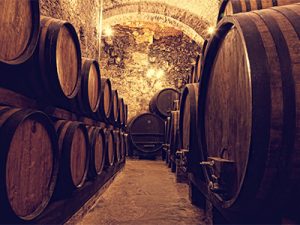
 One of the most important resources for wine is time. In fact, time comes into play in various ways throughout the entire production process.
For example, there is the time needed to make a new vineyard productive, or the time required for a plant to reach maturity. Then there is the time spent selecting the clusters, so that only raw materials of proven quality are used. Or, again, the time the wine spends in the cellar after fermentation, during which it is carefully monitored and “pampered” by the winemaker to ensure optimal development of the product. And then, in certain cases, there is the time for maturation and aging, during which special wines acquire their unique character.
For instance, our Battichiè Riserva del Fondatore 2019 rests for 6 months in tanks, 12 in French barriques, another 6 months in tanks, and finally between 6 and 8 months in the bottle before being released to the market.
Every stage of Battichiè’s long journey brings the wine toward higher quality levels. Once purchased, you can decide to open it immediately and discover its treasures. But, if you can control your curiosity and excitement, you can also choose to let the wine age further and postpone the tasting by a few months or years.
In general, fine wines like Battichiè can last a long time and evolve in interesting ways. They can do so even if they are stored at home, provided that some fundamental guidelines are followed. The goal is to cultivate the wine’s aging potential and prevent it from spoiling.
The right temperature and humidity
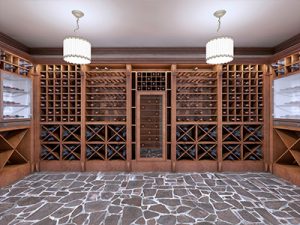 The first factor to consider for keeping wines healthy is the storage temperature. This must be regulated to allow the wine to rest and mature steadily and gradually. In general, the more the temperature rises, the more the wine’s vital process accelerates, and thus the wine exhausts its aging potential. However, the temperature must not be too low because wine is an organic compound that does not survive well in environments that are too cold. Therefore, first and foremost, it is essential to expose the wine to an appropriate temperature. To ensure steady evolution, it is also important to avoid thermal shocks: the temperature must be as constant as possible.
The ideal storage temperature for a wine is between 15 and 18 °C (59–64 °F). This is often called ‘room temperature,’ but in reality, every real environment (unlike an ideal one) has its own natural temperature, which is almost always higher than what we have indicated. However, there is no need to worry too much. In fact, if you really cannot find such a cool room in your home, then it is sufficient to store the wines at a constant temperature of 20–22 °C (68–72 °F). It is not too warm, and your wines will be perfectly comfortable.
In addition to temperature, it is also important to ensure that the storage environment is not too dry. A certain level of humidity is particularly important for keeping the cork soft and tightly adhered to the neck of the bottle. A lack of cork adhesion allows oxygen to penetrate too quickly, which is one of the most common ways to ruin a wine.
Many people store their wines in the kitchen. In reality, this is one of the worst places to store wine. In fact, between stoves, ovens, and other appliances that turn on and off, it is very difficult for the kitchen to have a constant and sufficiently cool temperature. The many odors and aromas typical of a kitchen also risk penetrating a bottle of wine over time and compromising its character. Therefore, if you can, think of another room.
And the fridge? Well, the fridge is also not exactly a good storage environment. The average temperature of a fridge is too low, and the humidity can also be insufficient. These are not favorable conditions for a wine’s evolution. In reality, the fridge only serves to cool a bottle that is too warm, especially if it is a white or sparkling wine. Generally, 20 minutes to an hour is enough.
Important wines should be pampered at home too
 You should try not to disturb the bottles, letting the wine rest as comfortably as possible. To this end, bottles should be stored horizontally. In this way, the wine will remain in contact with the cork, which will prevent it from drying out or shrinking, and will not allow oxygen to penetrate the bottle.
Just as it is normal for us to sleep better in a dark environment, in the case of wine, darkness promotes rest and steady evolution. Light is an enemy no less insidious than heat, as it can cause unwanted chemical reactions that often ruin wines. Never leave a bottle, even for a short time, in the sun or under intense artificial light.
A practical and simple idea to satisfy all these needs (temperature, humidity, olfactory neutrality, darkness) is to store the wines—and especially the most prestigious ones—inside a dedicated cupboard or closed cabinet. To improve thermal insulation, you can line the internal walls with polystyrene. And it is essential to clear the cupboard of any odors or perfumes.
Remember also that bottles must be handled with care. You must avoid jolts during transport and should not leave bottles in environments exposed to vibrations.
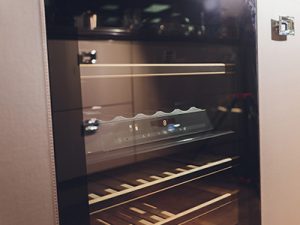
There are many types of wine coolers on the market, created specifically to store wines optimally. These appliances allow you to regulate fundamental parameters, such as temperature and humidity. They come in different capacities, even with separate compartments to store different types of wine differently.
Here, then, are several storage options. Your choice will depend on factors such as the type of environment available, the number of bottles, and the type of wine. You can start building your personal cellar by letting only a few bottles age (for example, three per type of wine), which you will then uncork after a few months or years. Gaining experience (even by making a few mistakes) remains the best way to learn. In this regard, I’ll give you one last tip: document your tastings in a notebook, indicating the date you uncorked the bottle and the additional storage time after purchase.
Tell me about your experience!
You might also like: Wine Me More: Nero d’Avola
Susana Alonso – Sorsi di Web